
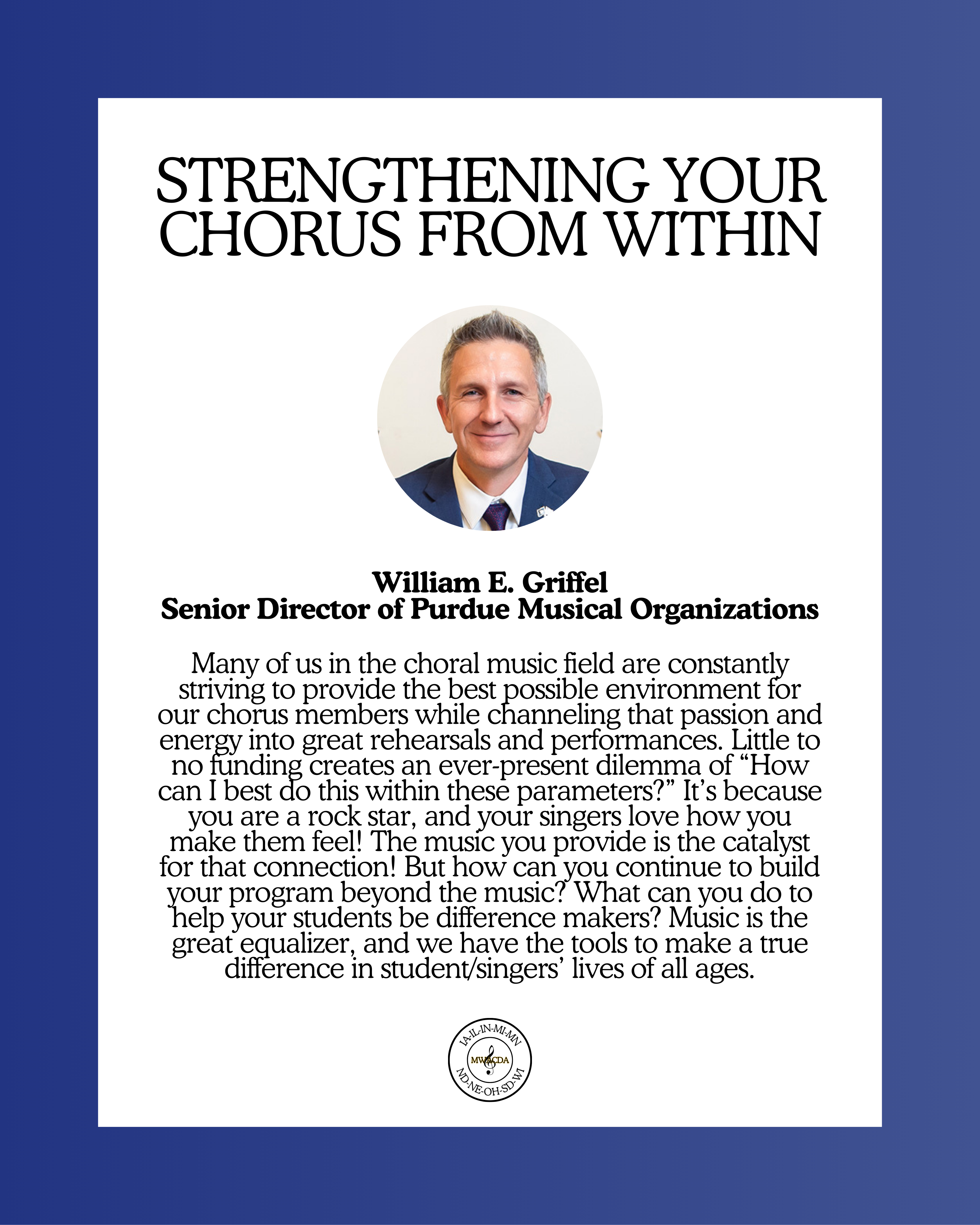
Strengthening Your Chorus from Within
William E. Griffel
Senior Director of Purdue Musical Organizations
Many of us in the choral music field are constantly striving to provide the best possible environment for our chorus members while channeling that passion and energy into great rehearsals and performances. Little to no funding creates an ever-present dilemma of “How can I best do this within these parameters?” It’s because you are a rock star, and your singers love how you make them feel! The music you provide is the catalyst for that connection! But how can you continue to build your program beyond the music? What can you do to help your students be difference makers? Music is the great equalizer, and we have the tools to make a true difference in student/singers’ lives of all ages.
I head a music program at Purdue University in West Lafayette, IN that is unique when compared to other university choral programs. Purdue does not have a school of music. It is the only university in the B1G conference without one. What that means is we have talented and dedicated students who want a high-level singing experience after high school but want to major in other things. Most university choral programs have music majors and a population of non-music majors as well.
In addition to their musical experience, we try to provide a baseline training of “soft skills” that have proven to be essential when students are ready to start the process of finding a life after college. In addition to their high-level musical experiences, we aim to provide personal and professional development opportunities that will have a meaningful and positive impact on their post-college life and strengthen our program from within. Some of these focus areas include:
- Teamwork and supervision
- Civility and conflict resolution
- Active listening
- Time Management
- Self-Reliance
- Networking
- Public Speaking
- Communication and interpersonal skills
- Fostering sensitivity, understanding and mutual respect for all individuals
It might be helpful to have a clear mission that can be shared with key stakeholders across your institution and in your communities. Let the community know what you believe and how students’ lives will be impacted. Here is an example our organization uses: “Our mission is to inspire, educate, and build community through the power of music. We are dedicated to fostering a welcoming and inclusive community that enriches the lives of our students, staff and supporters.”
Once you have that vision, you can work for a broader foundation for student enrichment through:
Education and Growth
We are dedicated to promoting lifelong learning and growth through music by creating an environment for students to learn, develop, and excel in their musical journeys.
Community Engagement
We will actively engage with our local and global communities, sharing the joy of music through performances, workshops, and outreach programs.
Diversity and Inclusion
We are committed to celebrating diversity and fostering an inclusive environment where individuals from all backgrounds and experiences feel valued, respected, and empowered.
Student Leadership
We will empower students to take on leadership roles, encouraging them to develop essential skills such as teamwork, organization, and communication.
Stewardship
We are committed to preserving and promoting the traditions of the organization while embracing change and progress.
For many of our schools’ administrations, organizational data is important. Recruitment numbers, GPA improvements, program benchmarks, etc. are important tools to boost your profile in your community. Using the data that highlights these important areas of focus and your program successes, is important information necessary to show administrators who control funding or provide essential opportunities for your department that your program is making a big difference in that community.
In addition, you might consider doing a SWOT analysis of your program to determine where your Strengths, Weaknesses, Opportunities and Threats are. This can be very helpful, and enlightening, to continue improving and providing the best experiences for your students. A peer reviews panel can also be very helpful with this process. If you are willing to have trusted colleagues look at your processes and structure you can really get creative with interesting programming and support.
Keep up the great work and don’t be afraid to tell your story!
About the author